

markaramjm
Thành viên
- Tham gia
- 4/3/2026
- Bài viết
- 18
For decades, industrial manufacturing operates under a predictable framework: if you wanted to build a metal component, you started with a massive forged block and machined away everything you didn't need. Subtractive manufacturing was the undisputed king of the factory floor. However, as modern engineering demands tighter tolerances, more complex geometries, and highly specialized materials, legacy techniques are hitting their physical and economic limits.
Today, industries ranging from aerospace and defense to energy and heavy automotive are pivoting toward advanced additive technologies. At the heart of this manufacturing revolution is a commitment to material efficiency, digital scalability, and automated control. By examining the mechanics, applications, and structural benefits of these new tools, we can understand how the global supply chain is being fundamentally reshaped.
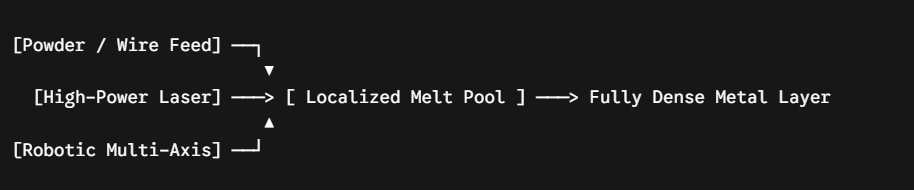
The process relies on a high-power laser source, often mounted to a multi-axis robotic arm or a CNC gantry, to create a highly localized melt pool on a substrate material. Simultaneously, raw metal feedstock—delivered either as a fine gas-atomized powder or a solid wire—is injected directly into that melt pool. As the laser moves along a digitally programmed path, the molten material solidifies almost instantaneously, bonding perfectly with the layer beneath it.
Because this technique builds parts from the ground up, it offers a near-zero waste environment. Instead of turning 80% of an expensive titanium or nickel-alloy forging into scrap shavings on a machine shop floor, manufacturers deposit only the exact amount of material required to satisfy the structural design.
Through modern material science and precise closed-loop monitoring, today's deposition systems allow for the creation of Functionally Graded Materials (FGMs) . Because the feedstock is introduced dynamically during the printing process, operators can literally alter the chemical composition of the metal mid-print. A component can seamlessly transition from a copper alloy to an Inconel superalloy within a single, continuous build session without creating a structural weak seam or artificial joint.
Furthermore, this technology achieves an incredibly refined microstructure. The rapid heating and cooling cycles inherent to laser-driven deposition create a dense, uniform grain structure within the metal. When subjected to post-processing heat treatments, these printed components regularly match or exceed the mechanical properties of traditional wrought or forged parts, satisfying the strict safety and certification standards of the aviation and defense sectors.
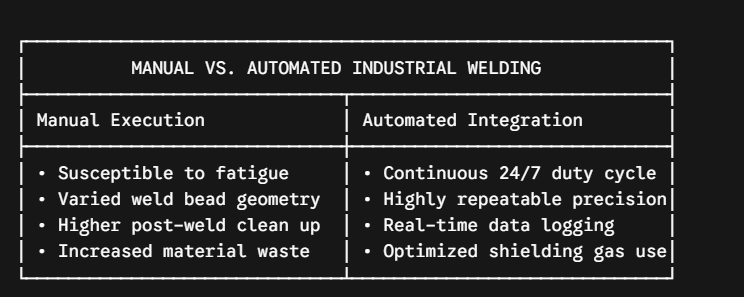
Traditional manual welding is a highly skilled art form, but it faces significant hurdles in the modern industrial landscape. Tight labor markets, human fatigue, and the natural variance in manual execution can introduce minor defects or inconsistencies into a production run. Automating these workflows removes these vulnerabilities from the equation.
Modern automated configurations combine high-speed robotic manipulation with real-time sensory feedback. Using laser-based seam tracking and optical melt pool monitoring, an automated system can detect micro-variations in a joint gap or part alignment and instantly adjust its parameters—such as travel speed, wire feed rate, or voltage—on the fly.
Instead of ordering a replacement part and waiting months for a hazardous supply chain to deliver it, companies can use a hybrid manufacturing approach:
By feeding this information into machine-learning algorithms, production facilities are building digital twins of their manufacturing processes. These systems can predict a defect before it happens, automatically adjust parameters to self-correct during a build, and provide an un-falsifiable record of part quality for regulatory compliance.
Finally, embracing these advanced additive and automated workflows is no longer just an optional strategy for forward-thinking R&D labs—it has become a requirement for any industrial operation looking to remain agile, cost-effective, and competitive on the global stage.
Today, industries ranging from aerospace and defense to energy and heavy automotive are pivoting toward advanced additive technologies. At the heart of this manufacturing revolution is a commitment to material efficiency, digital scalability, and automated control. By examining the mechanics, applications, and structural benefits of these new tools, we can understand how the global supply chain is being fundamentally reshaped.
1. Demystifying Laser Metal Deposition (LMD)
To understand where industrial production is heading, one must look closely at the mechanics of laser metallation . Unlike standard consumer 3D printers that melt plastic filaments, or enclosed industrial powder-bed fusion systems that operate within a restricted box, this methodology utilizes a dynamic, open-environment approach to metal fabrication.
The process relies on a high-power laser source, often mounted to a multi-axis robotic arm or a CNC gantry, to create a highly localized melt pool on a substrate material. Simultaneously, raw metal feedstock—delivered either as a fine gas-atomized powder or a solid wire—is injected directly into that melt pool. As the laser moves along a digitally programmed path, the molten material solidifies almost instantaneously, bonding perfectly with the layer beneath it.
Because this technique builds parts from the ground up, it offers a near-zero waste environment. Instead of turning 80% of an expensive titanium or nickel-alloy forging into scrap shavings on a machine shop floor, manufacturers deposit only the exact amount of material required to satisfy the structural design.
2. The Power of Advanced Metallic Tech
The rapid adoption of these deposition systems is heavily driven by breakthroughs in advanced metallic technology . Modern engineering applications no longer tolerate the limitations of single, monolithic materials when a component is exposed to multiple types of environmental stress. For instance, a rocket nozzle needs extreme thermal resistance on its interior liner, but high structural tensile strength on its exterior jacket.Through modern material science and precise closed-loop monitoring, today's deposition systems allow for the creation of Functionally Graded Materials (FGMs) . Because the feedstock is introduced dynamically during the printing process, operators can literally alter the chemical composition of the metal mid-print. A component can seamlessly transition from a copper alloy to an Inconel superalloy within a single, continuous build session without creating a structural weak seam or artificial joint.
Furthermore, this technology achieves an incredibly refined microstructure. The rapid heating and cooling cycles inherent to laser-driven deposition create a dense, uniform grain structure within the metal. When subjected to post-processing heat treatments, these printed components regularly match or exceed the mechanical properties of traditional wrought or forged parts, satisfying the strict safety and certification standards of the aviation and defense sectors.
3. Elevating Throughput with Automated Welding Solutions
While printing brand-new, complex components from a blank slate captures a lot of attention, the industrial reality is that existing assets need to be maintained, repaired, and joined efficiently. This is where the integration of abandoned welding solutions becomes a critical operational asset.Traditional manual welding is a highly skilled art form, but it faces significant hurdles in the modern industrial landscape. Tight labor markets, human fatigue, and the natural variance in manual execution can introduce minor defects or inconsistencies into a production run. Automating these workflows removes these vulnerabilities from the equation.
Modern automated configurations combine high-speed robotic manipulation with real-time sensory feedback. Using laser-based seam tracking and optical melt pool monitoring, an automated system can detect micro-variations in a joint gap or part alignment and instantly adjust its parameters—such as travel speed, wire feed rate, or voltage—on the fly.
4. Industrial Adaptation: Repair, Remanufacturing, and Hybrid Workflows
One of the most economically compelling use cases for combining laser deposition with robotic automation is in the field of industrial remanufacturing and component repair. When a high-value asset—such as a large gas turbine blade, an industrial stamping die, or a marine propeller shaft—suffers localized wear or cracking, scrapping the entire part represents a massive financial and environmental loss.Instead of ordering a replacement part and waiting months for a hazardous supply chain to deliver it, companies can use a hybrid manufacturing approach:
- Inspection and Prep: The damaged area of the metal component is digitally scanned using 3D blue-light or laser scanners to map the exact geometry of the wear or defect.
- Robotic Machining: A CNC tool or robotic arm machines away the contaminated or fatigued metal, leaving a clean, uniform surface.
- Additive Restoration: Using an automated laser head, new material is deposited precisely into the worn cavity, building it back up to near-net shape with a perfect metallurgical bond.
- Final Finish: The component is lightly machined back to its original OEM tolerances, restoring it to full service in a fraction of the time.
5. Looking Ahead: The Future of Digital Fabrication
As we look toward the future of global production, the line between software engineering and physical manufacturing will continue to blur. The true maturity of these advanced metallic systems lies in their ability to generate data. Every second a laser is firing or a robot is tracing a path, onboard sensors are collecting data regarding temperature, velocity, material flow, and acoustic feedback.By feeding this information into machine-learning algorithms, production facilities are building digital twins of their manufacturing processes. These systems can predict a defect before it happens, automatically adjust parameters to self-correct during a build, and provide an un-falsifiable record of part quality for regulatory compliance.
Finally, embracing these advanced additive and automated workflows is no longer just an optional strategy for forward-thinking R&D labs—it has become a requirement for any industrial operation looking to remain agile, cost-effective, and competitive on the global stage.